

What is Neuromarketing? An Introduction to the Consumer’s Mind
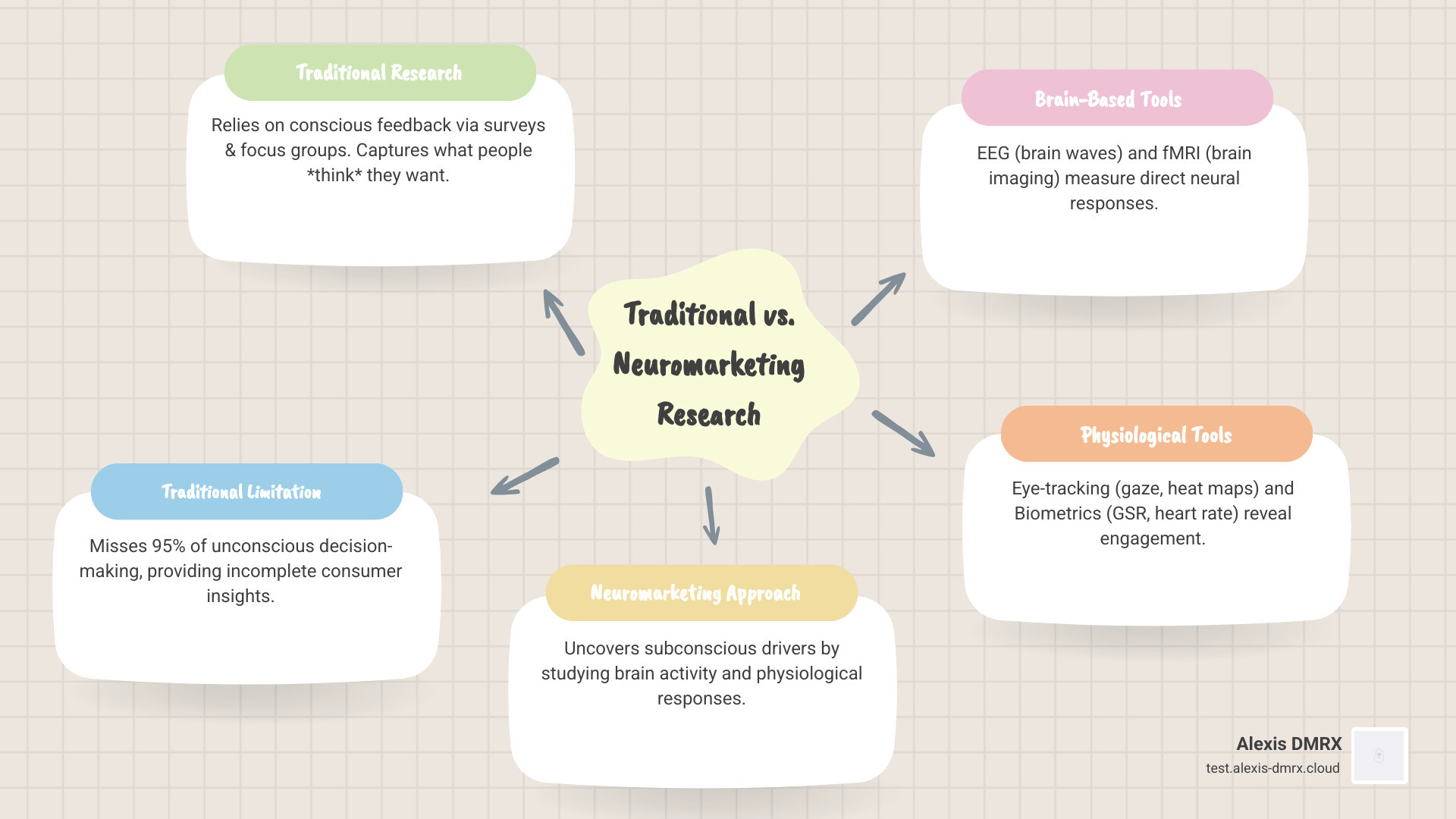
Neuromarketing is the application of neuroscience principles and techniques to understand consumer behavior by studying brain activity, physiological responses, and subconscious decision-making processes. It combines insights from neuroscience, psychology, and marketing to reveal why people buy, beyond what they say in surveys or focus groups.
Quick Answer: What You Need to Know
- What it measures: Brain activity, eye movement, heart rate, and other physiological signals when consumers interact with ads, products, or brands
- Why it matters: An estimated 95% of purchasing decisions are made unconsciously, meaning traditional research methods miss most of what drives behavior
- How it differs: Unlike surveys that capture what people think they want, neuromarketing reveals what their brains actually respond to
- Main tools: EEG (brain waves), fMRI (brain imaging), eye-tracking, and biometric sensors
- Market size: Valued at $3.3 billion in 2023 and growing rapidly
Nobel Laureate Francis Crick called it the astonishing hypothesis: the idea that all human feelings, thoughts, and actions are just products of neural activity in the brain. Neuromarketing takes this foundation and applies it to one of humanity’s oldest questions—what makes people choose one thing over another?
Traditional marketing relies heavily on asking people questions. But there’s a problem. When you see a luxury watch priced at $19.99 or a pack of gum for $20, your brain immediately knows something’s wrong—before you can even explain why. That instinctive reaction happens in System 1 thinking: the fast, emotional, unconscious part of your brain that handles most decisions.
System 2 thinking is slower, more deliberate, and rational. It’s what kicks in when you’re comparing mortgage rates or reading product reviews. But most buying decisions—especially impulse purchases, brand preferences, and emotional reactions—happen in System 1, where traditional surveys can’t reach.
That’s where Neuromarketing comes in. By measuring what happens inside the brain and body, researchers can see which ads grab attention, which designs trigger positive emotions, and which prices feel « just right »—all without asking a single question.
The field emerged in the early 2000s as brain imaging technology became more accessible. Since then, it’s evolved from experimental academic research into a practical tool used by companies like Coca-Cola, Frito-Lay, and IKEA to design everything from commercials to store layouts.
Whether you’re optimizing a website, testing ad creative, or launching a new product, understanding how the subconscious mind responds to marketing stimuli gives you an edge that guesswork simply can’t match.
The Science and Technology Behind Neuromarketing
At its heart, Neuromarketing is about understanding the biological drivers of consumer behavior. It operates on the core scientific principle that our decisions, feelings, and thoughts are rooted in neural activity. This means that to truly understand why a consumer chooses one product over another, we need to look beyond their conscious explanations and dig into their neurobiology.
We’re all familiar with cognitive biases—those mental shortcuts our brains take that can lead to irrational decisions. Neuromarketing leverages this understanding, exploring the interplay between emotional response and rational thought. While traditional marketing often assumes consumers make rational choices, we now know that emotions play a significant, often subconscious, role. As Nobel Laureate Francis Crick’s « astonishing hypothesis » suggests, our entire mental landscape, including our purchasing decisions, is a product of our brain’s intricate workings.
The field of Neuromarketing helps us reduce the uncertainty and conjecture that often plague traditional market research. Instead of asking people what they think they want or how they feel, which can be influenced by social desirability or a lack of self-awareness, we can observe their brains’ unfiltered responses. This allows us to gather more objective data on how consumers genuinely react to marketing stimuli, from advertisements to product packaging and pricing strategies.
This deep dive into the consumer’s mind is made possible by a suite of sophisticated technologies. Here’s a quick look at some of the primary tools we use in Neuromarketing:
| Technology | Cost Range | Mobility | Primary Data Type |
|---|---|---|---|
| EEG | €10,000 – €35,000 (per study) | Portable | Electrical brain activity (temporal resolution) |
| fMRI | >€1 Million (scanner) | Stationary | Blood flow in brain (spatial resolution) |
| Eye-Tracking | €100 – €30,000 (device) | Portable | Gaze patterns, pupil dilation |
These tools and the insights they provide are crucial for modern marketers looking to gain a competitive edge. To learn more about how these techniques provide unprecedented insights into consumer behavior, you can refer to « Neuromarketing: What You Need to Know » from Harvard Business Review.
How EEG and fMRI Uncover Brain Activity
When we talk about measuring brain activity in Neuromarketing, we’re primarily referring to two powerful neuroimaging techniques: Electroencephalography (EEG) and Functional Magnetic Resonance Imaging (fMRI). Each offers a unique window into the brain’s responses, with distinct advantages and applications.
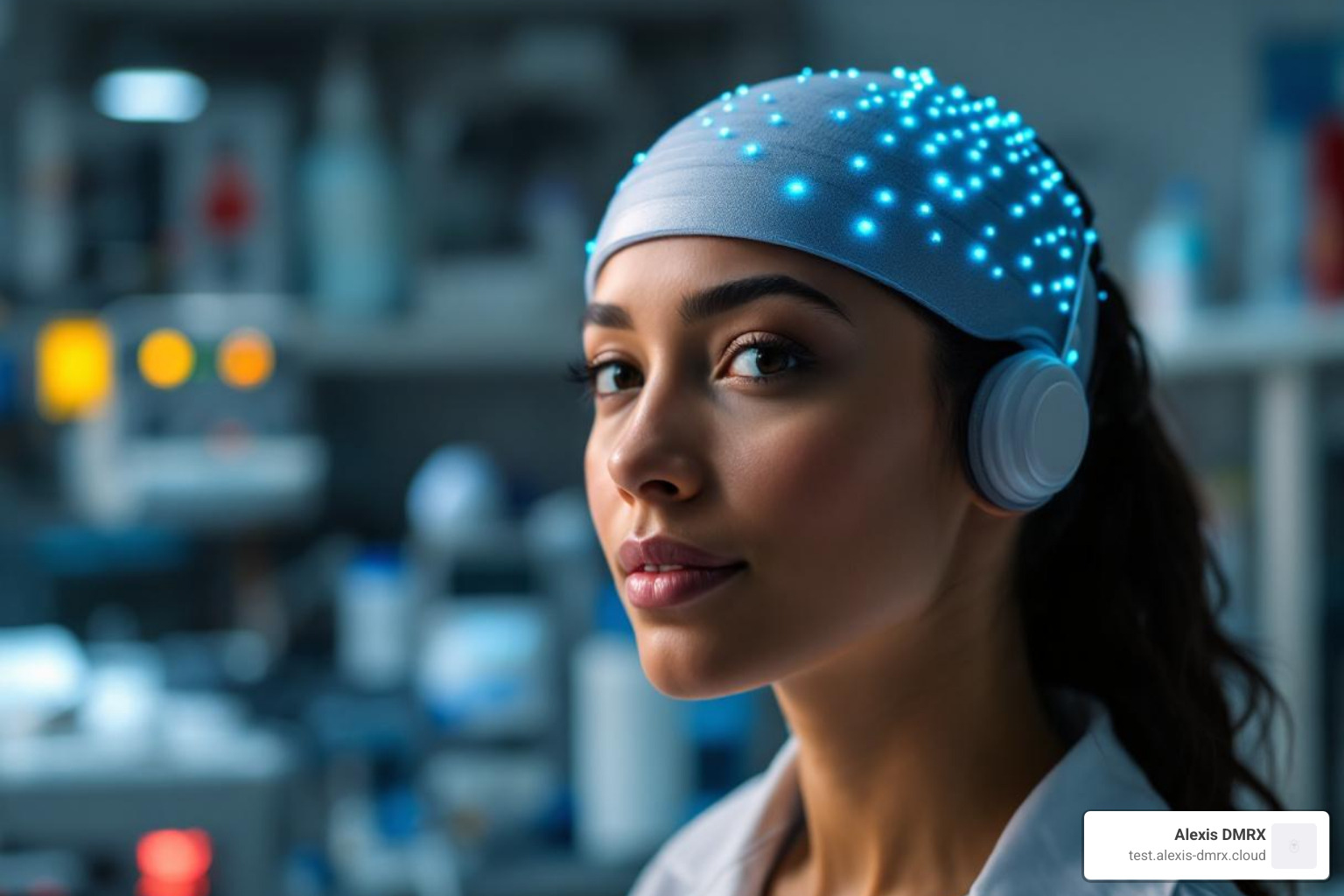
Electroencephalography (EEG) is like listening to the brain’s electrical symphony. It involves placing electrodes on the scalp to detect and record the electrical activity produced by neurons firing in the brain. The resulting squiggly lines on an EEG recording reveal brain waves, which can be associated with different states like attention, engagement, or emotional arousal.
What makes EEG particularly valuable for Neuromarketing is its excellent temporal resolution. This means it can capture changes in brain activity almost instantaneously, allowing us to pinpoint the exact moment a consumer reacts to a specific part of an advertisement or product. It’s also non-invasive, relatively mobile (especially with modern wearable EEG devices), and more cost-effective than other brain imaging methods. In fact, EEG is the most commonly used tool in consumer neuroscience research, appearing in approximately 60.5% of studies. We can use it to understand what happens inside the brain when someone is given or shown stimuli, such as an advertisement, product packaging, or even a verbal prompt, as explained by the Mayo Clinic.
Functional Magnetic Resonance Imaging (fMRI), on the other hand, gives us a high-definition map of brain activity. Instead of electrical signals, fMRI measures changes in blood flow—specifically, the Blood-Oxygen-Level-Dependent (BOLD) signal. When a brain region is more active, it demands more oxygenated blood, and fMRI detects these changes.
fMRI excels in spatial resolution, meaning it can pinpoint where in the brain activity is occurring with remarkable precision. This allows us to identify specific brain regions associated with emotions, memory, reward, and decision-making. For example, the famous Coca-Cola vs. Pepsi study used fMRI to show how brand knowledge activated brain regions associated with emotions and memories when subjects identified the drinks. While fMRI provides incredible detail, it’s a much larger, more expensive, and less mobile technology, requiring participants to lie still inside a large scanner. Despite its cost, it’s the second most frequently used technique in neuromarketing, appearing in about 14.5% of studies.
Eye-Tracking and Biometrics: What We See and Feel
Beyond direct brain activity, our bodies offer a wealth of subconscious signals that Neuromarketing expertly deciphers. Eye-tracking and various biometric measures provide crucial insights into attention, emotional engagement, and cognitive processing.

Eye-tracking technology monitors where a person is looking, their gaze patterns, and how long their eyes linger on specific elements. Imagine a heat map overlaid on a website or an advertisement: the « hotter » areas indicate where people focused their attention most. This reveals what truly captures a consumer’s interest, helping us optimize everything from ad layouts to website designs. Eye-tracking is incredibly popular in consumer neuroscience, being the second most used tool after EEG, appearing in approximately 17.5% of studies.
Complementing eye-tracking, pupil dilation is another fascinating metric. Our pupils involuntarily expand when we encounter something engaging, surprising, or cognitively demanding. So, if an ad leads to sustained pupil dilation, it suggests strong engagement and interest, while minimal change might indicate disinterest.
Other biometric tools offer even deeper emotional insights:
- Facial coding: This technique analyzes subtle micro-expressions on a person’s face to identify underlying emotions like joy, surprise, or confusion. While some sources caution about its scientific validation, it aims to capture unfiltered emotional responses.
- Galvanic Skin Response (GSR): Also known as electrodermal activity, GSR measures changes in the electrical conductivity of the skin, which is influenced by sweat gland activity. A high GSR reading during a commercial, for instance, often indicates increased emotional arousal or excitement.
- Heart rate monitoring: Our heart rate can also tell a story. When consumers encounter engaging, high-impact content, their heart rate typically increases, signaling heightened attention and emotional response.
Together, these techniques allow us to paint a comprehensive picture of a consumer’s subconscious reactions, revealing not just what they see or where they look, but also how they feel—all without them uttering a single word.
Practical Applications: How Brands Use Neuromarketing
This section explores how data-driven insights are reshaping marketing strategies across various domains. For more examples and case studies, visit our Blog.
Neuromarketing isn’t just an academic exercise; it’s a powerful tool that businesses are leveraging right now to refine their strategies and connect with consumers on a deeper level. By understanding how the brain processes information, brands can optimize their advertising, packaging, web design, and more, ensuring their messages resonate subconsciously.
Optimizing Advertising and Content
One of the most immediate applications of Neuromarketing is in creating more effective advertisements and content. Traditional ad testing often relies on surveys or focus groups, where people might consciously filter their responses. Neuromarketing bypasses this, providing unbiased feedback on what truly grabs attention and evokes emotion.
We can use tools like EEG to measure engagement and emotional peaks throughout an advertisement, identifying moments that captivate or lose audience interest. This helps us understand which storytelling strategies are most effective. For instance, a recent study found that storytelling strategies are shifting to audio-forward media, such as voice-over videos or podcasts, because they can catch and maintain a person’s interest more effectively than traditional video.
Real-world examples abound:
- Public Health Campaigns: The National Cancer Institute used fMRI scans to test three anti-smoking commercials. They found that brain activity in response to one particular ad correlated with an increase in hotline calls, providing powerful evidence of its effectiveness.
- Brand Perception: The famous Coca-Cola vs. Pepsi fMRI study revealed that when consumers knew they were drinking Coca-Cola, their brain activity in regions associated with emotion, memory, and unconscious processing showed improved activity, even if they couldn’t distinguish the taste in a blind test. This showed the immense power of branding over pure product experience.
- Emotional Resonance: It’s widely understood in Neuromarketing that emotional ads work best. By tracking physiological responses, we can confirm which narratives generate feelings of joy, connection, or excitement, leading to more impactful campaigns.
Enhancing Packaging and Product Design
Packaging is often a consumer’s first physical interaction with a product, and Neuromarketing plays a critical role in ensuring it makes the right impression. We can use neuroscientific tools to understand how different designs impact shelf appeal, sensory perception, and even perceived value.
Consider these insights:
- Frito-Lay’s Packaging Redesign: Through Neuromarketing techniques, Frito-Lay finded that matte bags with pictures of potatoes triggered a more positive consumer response than shiny bags. Based on these insights, they revamped their chip packaging design, demonstrating how subtle changes can have a significant impact.
- Sensory Marketing: The look, feel, and even smell of a product can influence purchasing decisions. Neuromarketing helps us understand these subconscious sensory preferences.
- Color Psychology: We know that colors evoke specific emotions. Research on brain activity has shown that the color red signifies strength, which explains why it’s the favored logo color for so many iconic brands, including Coca-Cola, Target, McDonald’s, and Netflix.
- Perceived Value: An intriguing study scanned the brains of test subjects while they tasted three wines, each labeled with a different price. Their brains registered the wines differently, with neural signatures indicating a preference for the most expensive wine—even though all three wines were actually the same. This highlights how our perception of value can be heavily influenced by external cues like price.
- Subtle Brand Cues: Neuromarketing research has also shown that people react favorably to movement and speed. This knowledge guided FedEx to include a hidden arrow in its logo that represents quickness, garnering favorable, subconscious brand trust among consumers.
Improving Web Design and User Experience (UX)
Our websites and apps are often the primary touchpoints with consumers. Neuromarketing provides invaluable insights into optimizing web design and user experience (UX) to improve engagement, reduce cognitive load, and drive conversions.
By employing eye-tracking, we can see exactly how users steer a webpage, where their attention lingers, and what elements they overlook. This informs optimal placement for critical information, call-to-action (CTA) buttons, and visual cues. We can also measure cognitive load (how hard the brain is working) using EEG to ensure that interfaces are intuitive and don’t overwhelm users.
- Optimizing Layouts: IKEA, for example, has designed its stores in a way that showcases everything they sell before a consumer can actually leave, thus increasing the likelihood of a purchase. This layout was developed using Neuromarketing research, demonstrating how understanding human behavior can lead to highly effective physical and digital designs.
- Conversion Rate Optimization (CRO): By understanding the unconscious choices that drive buying behavior, we can adapt marketing materials and website elements to improve those triggers, leading to higher conversion rates. This includes everything from optimizing product images to streamlining checkout processes.
Benefits, Challenges, and the Future of Consumer Neuroscience
The field of Neuromarketing is experiencing rapid growth, with the market size valued at nearly $3.3 billion in 2023. This expansion reflects a growing recognition among businesses of the competitive advantage offered by understanding the subconscious mind. However, like any emerging science, it comes with its own set of challenges, particularly around data interpretation complexity and the limitations of sample sizes in laboratory settings.
Key Benefits of Applying Neuromarketing
The allure of Neuromarketing lies in its ability to offer insights that traditional research methods simply cannot. We’ve seen how it transforms guesswork into scientific understanding, leading to a host of tangible benefits for businesses and marketers:
- Deeper Consumer Understanding: It moves beyond conscious responses to uncover genuine, unfiltered reactions, revealing the true drivers of consumer behavior. We gain insights into attention, cognition, emotions, and memory that consumers themselves might not be aware of or able to articulate.
- Unbiased Feedback: Unlike surveys or focus groups where participants might give socially desirable answers, Neuromarketing provides objective data on physiological and neural responses. This removes the human choice element in market research, exposing a person’s real responses.
- Improved Predictive Accuracy: Neural data has shown promise in predicting market-level outcomes more accurately than traditional self-report methods. This means better forecasting of product success and advertising effectiveness.
- Increased ROI on Marketing Spend: By pre-testing ads, packaging, and digital experiences, businesses can ensure their campaigns are optimized for maximum impact before large-scale deployment, leading to more efficient and effective marketing.
- Reduced Product Failure Risk: Understanding subconscious preferences early in the product development cycle can significantly lower the risk of launching products or campaigns that fail to resonate with the target audience.
Ethical Concerns and Criticisms of Neuromarketing
With great power comes great responsibility, and Neuromarketing is no exception. As we dig deeper into the subconscious mind, ethical questions naturally arise. Concerns about consumer manipulation, privacy invasion, and the potential for misuse of insights are frequently discussed.
- Consumer Manipulation: Critics often worry that Neuromarketing could be used to bypass consumers’ rational defenses, essentially creating a « buy button » in the brain. This fear suggests that marketers could exploit subconscious triggers to compel purchases against a consumer’s best interest. While the idea of a single « buy button » is largely a myth, the potential to influence behavior without conscious awareness is a valid concern.
- Privacy Invasion: The collection of sensitive neural and physiological data raises privacy questions. Who owns this data? How is it stored and used? Ensuring that participants provide informed consent and that data is anonymized and handled responsibly is paramount. For example, when a political party in Mexico used Neuromarketing to learn about voters’ reactions to campaign ads, the information leaked, causing a backlash and likely costing the candidate votes. This highlights the critical need for robust ethical protocols, an issue that arises when neuromarketing crosses the line.
- Pseudoscience Claims: Early in its development, some critics dismissed Neuromarketing as a pseudoscientific fad, arguing that many claims made by companies weren’t based on solid neuroscience. While the field has matured and become more rigorous, the need for scientific validation and transparent methodologies remains crucial to build trust and credibility.
At Alexis DMRX, we believe that ethical application of Neuromarketing focuses on understanding consumer needs to improve products and messaging, not to force purchases. Informed consent, data protection, and a commitment to using insights to create genuinely better customer experiences are the cornerstones of responsible practice.
The Future of Neuromarketing: AI and Beyond
The journey of Neuromarketing is far from over; in fact, it’s just accelerating. The integration of cutting-edge technologies like Artificial Intelligence (AI) and the rise of immersive experiences promise to open up even greater insights and efficiencies.
Here are some of the exciting future trends we anticipate:
- Artificial Intelligence (AI) Integration: AI is set to revolutionize Neuromarketing by enhancing data interpretation, enabling more precise predictions, and providing real-time insights from vast datasets. AI algorithms can analyze complex neural and physiological data patterns much faster and more accurately than humans, making studies more accessible and scalable.
- Real-time Personalization: Imagine an online experience that adapts instantly to your emotional state or level of engagement. With AI-driven Neuromarketing, real-time physiological and neural feedback could enable personalized content, advertising, and user interfaces that optimize for individual preferences and responses.
- Virtual and Augmented Reality (VR/AR) Applications: VR and AR offer immersive environments for conducting Neuromarketing research. We can create highly realistic simulations of shopping experiences, product interactions, or advertising scenarios, allowing us to study consumer behavior in controlled yet naturalistic settings without the logistical challenges of physical spaces.
- Wearable Technology: As EEG devices and biometric sensors become smaller, more comfortable, and integrated into everyday wearables, Neuromarketing research will move out of the lab and into real-world contexts. This will allow for continuous monitoring of consumer responses in their natural environments, providing unprecedented ecological validity.
- Ethical and Transparent Practices: As the field evolves, there will be an increased emphasis on establishing clear ethical guidelines and fostering transparency. This includes stricter data protection measures, clearer communication of study goals, and a commitment to using Neuromarketing for consumer benefit rather than manipulation.
Frequently Asked Questions about Neuromarketing
Is neuromarketing the same as manipulation?
Neuromarketing aims to understand consumer needs to improve products and messaging, not to force purchases. Ethical application focuses on creating better experiences, distinguishing it from manipulation, which implies coercion or deception.
Can small businesses afford neuromarketing?
While traditional fMRI studies are expensive, more accessible methods like web-based implicit testing, simplified EEG, and applying established principles from public research are making Neuromarketing insights available to smaller businesses.
How accurate is neuromarketing in predicting sales?
Studies have shown that neural data can predict market-level outcomes more accurately than traditional self-report methods like surveys. For example, brain activity in response to movie trailers has been linked to box office success.
Conclusion: Decoding the Future of Marketing
Neuromarketing provides an unprecedented window into the consumer’s mind, moving beyond what people say to understand what they truly feel and want. By ethically applying these powerful insights, businesses can create more resonant, effective, and customer-centric marketing. Alexis DMRX is dedicated to navigating this exciting field. To learn how these principles can transform your strategy, explore our services at https://test.alexis-dmrx.cloud/.
Ping : Automatisation: Your #1 Ultimate Guide